Thursday, March 8, 2012

First Orthopedic Clinic, March 8

Today was an exciting morning. Kasun (one of the P & O clinicians) and I attended a orthopedic clinic. Our purpose was to introduce ourselves to the new orthopaedic surgeon and inform him of our services, answer any questions he might have, and generally be a presence if needed. We discussed a few cases with him, but it was mostly a lot of broken bones and surgical cases. There were so many patients that broke my heart when hearing their stories. One young man had his leg run over by a wooden cart during a religious Hindu ceremony: It was an awful mess of scar tissue and contractures. Nothing could be done for him, because of the extensive scar tissue. Another man came for treatment after he had been beaten by his superior officer in the army. Initially, the army refused him treatment, and he was given traditional medication. This obviously did nothing for his broken bones, and resultantly he has contractures and deformities. Another young boy (about 6 years old) was left in a cast for too long, and so he has about 30 degrees of elbow range of motion. The clinic was an eye opener. It makes you feel so grateful to be healthy.

After eating another meal (lunch) of rice and curry, I decided to buy some food at the grocery store and take it home for dinner. I could not bear any more rice. This is a much more expensive option, as you can get a rice and curry meal for about $2 or 3, where as my groceries were about $15. I bought knife, a pineapple, cereal, yogurt, and mango juice. I never would have guessed this would taste so yummy!

Wednesday, March 7, 2012

Full moon

Main street of Vavuniya, called Kandy Rd
March 7, National Holiday

Today the clinic is closed due to the National holiday, for the full moon (something which I think we Canadians should adopt... a holiday for full moons. Why not?). I spent the morning skyping with friends and family, which was really nice. Then I got ready and set out on the town. I had wanted to map out my route to the hospital and see how long it would take me to get there. I also wanted to grab some lunch.
I was told that young women really enjoy going to Danis for coffee and food, so I thought I would check it out. After looping around the shop many times, I realized it was only for cakes and coffee, not much of a lunch menu. I must have looked lost, because a man asked me what I was looking for. I asked him about a lunch menu, and he said to go upstairs for meals. On the top floor was a restaurant that served ... can you guess? More rice and curry, or fried rice with cury to add a little variety. It was tasty, but I am so sick of rice and curry. I don’t understand how people don’t get bored of this menu?


Bustling streets of Vavuniya
After lunch I spent the afternoon just walking around the town to see the sights. There were people everywhere. It is certainly a busy little town. Even the cows were out, crossing roads or sitting on sidewalks checking out the sights. The town's colors are amazing; women dressed in the most colorful saris, brightly colored buildings mixed between tin roof shacks, vendors selling more saris in all colors of the rainbow, fruit stands with bright ripe produce, the dirt roads are a burnt red color, and the heat has turned the vegetation dry and brown. The atmosphere of the town is hard to describe. It is a blend of so many bright colors, yet run down by poverty. Of course, I was the object of many stares during my walk, due to my blonde hair and white skin. Lots of men saying "hello miss". Police men kept asking if i was lost. I took some pictures of the town. I almost got hit by a tuk tuk while doing so, but luckily a few men came to my rescue and yelled at the driver.

After circling the main streets I decided to head home for a siesta. I turned down a street to my place to see a man in wheelchair waving at me frantically. I thought perhaps he was someone that worked at the clinic (there are many wheelchair users employed by the clinic, because they want to show they are contributing members to society and are not a burden, as most think of disabled people here)... but no, just a very friendly man wanting to speak English. He had lived in London, England for several years but was coming back to Sri Lanka for treatment for a spinal infection. We talked for a bit, and then I left.

Tuesday, March 6, 2012

Vavuniya

My monkey friends


Due North, heading to Vavuniya

After a little bout of food poisoning on Sunday night I was not too happy about the idea of bouncing around in the mini van for an afternoon with Mary and her driver. I knew the roads wouldn’t be smooth, combined with the way people drive in Sri Lanka, I wasn’t sure my stomach could handle the tossing about. My trip on the train to the SLSPO in the morning was difficult enough. I knew I would faint soon because I was seeing nothing but blackness. Since there weren’t any seats, I had to sit on my haunches until we got to Ragama. David and Hanna offered to carry my luggage up to the school when we got to the station. Ugh, not fun.

prayer flags
After a morning at the school, Mary and I left for the north part of Sri Lanka, where I would be spending the next 2.5 weeks. According to Mary we would arrive in Anuradhapura after 4 or 5 pm, stay there for the night and continue to Vavuniya in the morning. We arrived at 3:15 pm; Mary said this was record time, as the roads had recently been resurfaced. I slept the whole way up, and I felt a million times better. I awoke once during the car journey to see an elephant on the flat bed truck in front of us. Mary said it was likely being transported to a construction site. Apparently they use elephants like we use cranes to move heavy objects. I felt sorry for the poor elephant, as it was chained to the truck and was wobbling back and forth. The poor thing must have been scared.


3rd or 4th century Buddha

After arriving at our hotel and dropping our things off, we made our way over the ancient city of Anuradhapura. It is a sprawling complex of ancient wonders, crumbling towers, and grand Buddhist temples all mixed together. The grounds were huge and we had to drive from one ancient ruin to another. Mary pointed out a few varieties of flowers and species of birds along the way. We also saw some monkeys running around the grounds. The gardeners at Anuradhapura were preparing for the national holiday that would be taking place on Wednesday. Apparently there would be a huge celebration for the full moon, which is a national holiday The grounds were very barren looking, and not many "gardens" to speak of. Apparently there has been a drought, so there wasn’t much greenery to speak of. A few flowers on trees but that was about it. Not like the parks we are used to in Canada.


We stayed at a hotel called Boa Vista. It was a nice place over looking a "lake" (pond really). Mary is friends with the hotel owner, so we were received with open arms and had dinner with the owner. The hotel is run by a Sri Lankan couple who had lived in Canada for 25 years, but decided to open the hotel for some additional income. Sadly, the hotel was not as successful as they had hoped. Now, the wife is running the hotel, while her husband is working in Canada. The wife was spoke to us about the difficulties of running a hotel in Sri Lanka. She said that tourists expect the prices of hotels and food to be as cheap as in India. This is not a reality in Sri Lanka, because it is technically an island, with island prices. The rising cost of fuel, food, and electricity have had a huge impact; especially for those who are only making a few dollars a day. A lot of travelers are using the Lonely Planet book as reference for prices and hotel costs, but since it was published in 2009 it really isn’t a correct or fair estimation. The owner said traveler’s constantly feel as though people are ripping them off because of the Lonely Planet, but this isn’t true considering the economy today. Tourists arguing about 1 or 2 dollars, which is a huge difference in the lives of some of these people.


We awoke the next day at 5:30 am, so we could be on the road to Vavuniya at 6:30 am, to arrive at 8 am. As we drove further north, I began to see a strong military presence throughout the country-side. There were check-points along the roads, where guard could pull over cars to be searched at radom. Guards could be seen walking down the roads in their uniforms, with guns slung over their shoulders. We were stopped once along our journey to have our car searched. When the guard opened the sliding door of the van and saw two white faces peering back at him we were waved on. I was told that the Tamil conflict has mostly been stopped, and a lot has been done to control conflict over the last couple of years. The situation with the Tamil LTTE is considered to be stable so the military presence has been greatly reduced over the last few years and most of the NGO’s have left the area. Nevertheless, while in town one day, I saw a jeep with "landmine clearing" written across its doors. For the most part things look pretty normal in the rural town of Vavuniya, and you wouldn’t suspect it was under heavy conflict a few years ago. However, when I am in clinic seeing patients this is a different story.


Flower offerings at the temples

We arrived at the clinic for 8 am. Mary introduced me to the P & O staff and we took a tour of the clinic and technical areas. Following this, meetings were arranged for me to meet the new orthopedic surgeon on staff (he just finished his training in the UK and appeared very keen and interested in the P & O department at the hospital) and the Hospital’s chief of staff. Later in the morning I assisted the other clinicians with 3 orthotic assessments and prescriptions. We saw one little girl, and 2 adults who were victims shell blasts.
The chief of staff at the hospital is very interested in statistics, so the P & O department were encouraged to keep track of who they are seeing, what they are seeing them for, and their pathologies. I believe the statistics are something like this: In 2011, 198 prosthetic patients, 220 orthotic patients. Greater than half of both P & O patients were a result of war accidents or landmines. I was surprised to see that there were more orthotic patients. I would have expected to see the opposite. I think I will have the opportunity to see a wide variety of patients and my time at the clinic will prove to be interesting. The orthopedic surgeon said to me "you will see all sorts of surprising and inhumane things people survive in this 3rd world country".

Friday, March 2, 2012

First weekend trip in Sri Lanka: Hill country

Lucky for me my weekend adventure was not a solo event.  Hanna was kind enough to agree to accompany me, and together we convinced Emil to come along.  He had only one concern; a cross-country skiing event that is famous in Sweden that was being televised on Sunday.  It was very important that he return for Sunday.  Oh the Swed’s and their Nordic sports.  Ha ha.   So the three of us decided to go to the “hill country” for the weekend.  This is the central part of the country where they make tea.  It is one of Sri Lanka’s largest exports.   We also decided we would climb Adam’s peak, also known as Sri Pada.  It is one of the highest mountain ranges in Sri Lanka, approximately 2,250m and has been a pilgrimage site for thousands.  It is known as Adam’s peak for various reasons, depending on religious belief of those ascending it. For some it is the place where Adam set foot on the earth after being cast out from heaven; for others it is the sacred footprint left by the Buddha as he headed towards paradise; or the Butterfly mountain where butterflies go to die: or it is the footprint crowning the peak to be that of St Thomas the early apostle of India.  The pilgrimage season begins in December and runs until May. There are countless steps to the top, and the pathway is light by vendors and lights along the way.

After a day at the school Hanna, Emil and I made a mad dash for the train station.  We were released a little early from SLSPO (Sri Lanka School of Prosthetics and Orthotics aka the school) and wanted to make sure we started our trek early.  We had consulted one of the other ex-pats (Eleanor from England, Elly) at the school about where we should stay and how long it would take us to do things.  She gave us names and numbers for hotels, as well as advice on transport.   Elly told us it would take us a little over 3 hours to get to our weekend adventure.  This was a very incorrect estimation I later found out.  However, I am glad she under estimated the time, as I am sure Emil or Hanna would have backed out.   

After our dashing about, we arrived at the train station sweaty, but on time.  No one runs in Sri Lanka, because its too darn hot.  Honestly!  Who runs in 40 degree weather (plus humidity)? Only foreigners.

After the train all 3 of us squeezed (with our baggage) into a tuk tuk to arrive at the bus station. We made it just in time … to wait.  Apparently they don’t run a strict bus schedule, it’s just whenever the bus is full.  After about a hour of waiting we were on our way.  It was an interesting experience, to say the least.  The driver was crazy.  He was really fast compared to all the other drivers on the road. Not only was the speed crazy, but he would drive down the middle of the road, honking at tuk tuks, motorbikes, other cars, and small buses to get out of the way.  He would only stay on his side if the vehicle was a truck or bus that was larger.   A few times we narrowly escaped a head on collision.  Despite my opinion of the driver, Hanna told me this was one of the better bus drivers.  Yikes!   Along our journey we picked up other passengers, at “bus stops”; the assistant driver would hang himself out the side door yelling the destination of our route. When he spotted someone who wanted to travel with us he would warn the driver, he would subsequently slow down and people would hop on. One man tripped and fell during one of these “bus stops”. I was certain he was under the tires of the bus; I feared we would end up with a dead man or an amputee.  However, he popped up from the ground and got on the bus.

The roads were rough, lined with vendors selling anything from fruits and vegetables to plastic toys.  The “stores” (I write this in quotations, because some were more like a shack) were selling washing machines, treadmills (really? In this heat?), and other random things.   Very strange sights.  The Bollywood music was blaring out of the bus’ speakers the entire way, as we bumped along the road.  The young guy who was sitting next to me fell asleep and used me as a convenient leaning post. Not fun, especially when the seats are already so narrow. 

We arrived at 11:30 pm at our hotel in Dalhousie, in the hill country; River View Wathsala Inn.  The lights were all off and we were obviously the last guests to arrive.  Emil, Hanna and I shared a room together, which helped to save a few Rupees.  I got a twin bed, which was an “interesting” piece of furniture.  The bed was slatted, but the slats were so far apart that the mattress with me included, fell between each slat.  Oh well, I wasn’t there for long.  We were told by Elly that we had to start our hike at 2:30 am in order to be at the summit for 5:30 am.  It seemed utterly ridiculous to be venturing on this hike so early, however the end goal was definitely worth the effort.  

A wonderful bonus to this trip was the cool temperatures.  During the night the temperatures dropped to about 10 or 15 degrees celsius (you can see my scarf and Emil's hood in the photos).  This was a much needed relief from the muggy air in Columbo.  I loved climbing into my warm clothes, and using a blanket at night.  It reminded me of fall in Canada. However, the Sri Lankan's dressed like they were the north pole.  I even saw some of them climbing with Santa hats on (however, still had their flip flops on).  I laughed. I can now understand why I see people marching around Toronto in the summer with a toque or coat on. During the day it warmed up to about 25-30 degrees.  Lovely!  Again, the Sri Lankan's still think it isn't warm.

The hike began in darkness, along Hatton Road.  The only lights were that of the vendors which lined the path, as well as the “street lamps” shinning from above.  Buddhist flags (red, white, yellow, and blue) were hanging above our heads and along either side of the path.  Despite the late hours, there were ample people about.  As the night progressed and the stairs kept looming before us, there were more and more people. It wasn’t just a path travelled by people my age, but anyone from infants in their mother’s or father’s arms, toddlers, to people in their seventies or even eighties.  I do admire all the efforts; some had people pushing or pulling them up the thousands of steps to the top.   The last few stairs were the worst, because of the utter mayhem; there were so many people trying to get to the top.  The actual top was such a small area, that it was no wonder there was a kind of traffic jam.  


Making our way to the top under the night sky
Sunrise at the top of Adam's Peak, Sri Pada
Emil, Hanna, myself, and thousands of Sri Lankan's; we made it!
After battling the crowds we got to the top at about 5:30 am, and awaited the sunrise.  It was spectacular, for a lack of better description.  The colors of the sun were amazing, and the beauty of the landscape was sprawling before us.  I also think sharing this experience with literally thousands of others made the event even more amazing.  

Since this is a religious pilgrimage a prayer procession began at 6:30 am (I think).  The Buddhists bent down and began to pray to the Buddha that was situated at the top of the mountain.   The chanting was interesting and soothing as you watched the sunrise.  


A taste of the chaos
The color Buddhist flags seen along our pathway
Making the descent
You can see the shadow of Adam's peak in the background; its the pointy cone shape 
After taking numerous photos Emil, Hanna and I began our descent.  This was also a challenge.  After a while your thighs were so fatigued they began to shake.  When we finally made it back to the hotel we quickly ate breakfast, showered and packed up. Emil went home to Columbo to ensure he was home for the skiing event, while Hanna and I headed off on another 2 hour bus ride further East.  We went to the town of Nuwara Eliya, known for its tea.   


Labookellie Tea Factory, Nuwara Eliya
Our new hotel owner, Wasantha Thalpage, met us at the bus station.  He organized a driver to take us to the tea plantation, Labookellie Tea Factory.  Once we arrived at the estate, the driver waited for us as we went on a tour of the factory, enjoyed the aromas of the drying tea leaves, had a cup of complimentary tea on the veranda over looking the hills, bought some tea to take home with us, and took some pictures of the Tamil ladies picking the tea leaves. 


Drying tea leaves
Here are some interesting tea facts:
Tea came to Sri Lanka when the coffee plantations were decimated by disease in the 19th century. In 2008, Sri Lanka overtook Kenya as the second most important tea producing nation, with an annual production of 330 million kg.  Sri lanka tea (branded as Ceylon tea) sells at auction at prices 50% higher than its rival and market leader India.  Despite this, wages for Tamil tea pickers is extremely low, about $3/day – where the pickers must pick a minimum of 20 kg of tea leaves a day.  Tea bushes are pruned back to 1 m in height, every 5 years, and the tea pickers (all women) move through rows of the bushes picking the leaves and buds (light green leaves not the dark green, as we were told at the factory).  The bushes usually last about 60 years, are then uprooted.  The leaves are brought to the factory and withered by air blowing at them through mechanized troughs.  The leaves are then crushed, starting a fermentation process.  The art in tea production comes in knowing when to stop the fermentation, by firing the tea to produce the final, brown-black leaf.  Tea is graded by the size and quality.  The finer the tea is cut or crushed the stronger the tea, the larger the leaves the lighter the taste.   
Tamil women picking tea leaves

After we finished our tour of the factory, our driver brought us to King Fern hotel.  An amazing little hotel located in the hills of Nuwara Eliya.  It was a very quaint sight, with beautiful gardens, and run by the most pleasant Sri Lankan couple.  The welcomed us provided us with a room overlooking the town, so we could wake up and see the sunrise over the horizon (yes, we woke up again very early.. ugh).  Hanna and I were both extremely tired after our day of hiking, sight seeing, and traveling.  We ate dinner at the hotel and then went to bed at 8pm.   


Sunrise from our hotel veranda

On Sunday we awoke to another fantastic sunrise, at 6 am.  After we enjoyed the view we had breakfast, which was eggs, toast with pineapple jam, fresh fruit, and coffee (the coffee actually tasted ok).  We asked Wasantha were we could find a good place to hike.  He was surprised we were willing to tackle another climb after yesterday’s adventures.   Wasantha volunteered to take us on a hike up the highest peak in Sri Lanka, Mount Pedro.  He told us it was not a well defined trail, and he would need to accompany us.  So after he helped his wife with getting the other guests breakfast, off we went.  We definitely would not have found this place on our own.  There were a few times we were battling leaves and bushes, we even heard a wild boar running down the mountain!  


Top of mount Pedro
We reached the top of Mount Pedro, and before us was this wonderful view.  You could see for miles and miles the tea estates.  Wasantha gave us a little education on the area as well as explained some of the plants and trees.  It was a great finish to our weekend.   After a stop to enjoy the view, we had to promptly get down the mountain, as we had to catch our train in a couple of hours.  Hanna who is very tall, picked up her pace and soon left Wasantha and I in her dust.  It is very hard to keep up to a Swedish gazelle!  Poor Wasantha had to run to keep pace with her.  I have never seen a Sri Lankan move so quickly.  

Wasantha and myself
When we got back to the hotel we quickly packed our bags, and Wasantha's wife had a lunch packed and ready for us to take on the train.  How amazing is that?  Such a great couple.  I don't think I have been treated so well at any other hotel I have ever stayed at.  I will definitely write a raving review on Trip advisor for them (the hotel owners in Sri Lanka rely very heavily on the reviews from trip advisor.  If they dont make it into the books like lonely planet or on the internet, then they don't survive). 

We took the train back to Columbo passing through the hill country.  It was a scenic ride, and allowed us to see some more of the country.  After 7 hours on the train we arrived home.  I had to quickly do a load of laundry and pack my bags.  Monday I would be heading north to Vavuniya.  This will begin my mentoring or teaching at the prosthetics and orthotic clinics…. The actual purpose of this trip! 


Thursday, March 1, 2012

Sri Lanka so far


This will be a quick entry, as I really need to get to bed.  Tomorrow will be another early start at the school.  We leave at 6:15 am, to take the 6:30 train from Columbo to Ragama.  The train ride is 25 minutes. The first day I was driven to the school by Mary's driver, who picked me up at her house.  (She was gracious enough to let me stay at her place when I arrived at 1 am). Today I did commute by train. 
So far life in Sri Lanka is completely different that Bangkok.  Bangkok is a modern city by all standards; fancy shopping malls, condos, etc.  Here in Sri Lanka life is a little more simple and rustic. 
(I will talk more about the school in my next entry, but today I really wanted to start with the train).  Lucky for me, my commute to the school in Ragama is in the opposite of the commuters heading into Columbo city.  The train heading opposite to mine (whether its in or out of the city) is always packed; people hanging out the doors, and even on the roof like you see in pictures of the National Geographic magazines.  Its crazy.  My first day on the train I was lucky enough to see this chaotic sight.  Not every train is that packed to the point there are people on the roof, but for some reason yesterday's commute was particularly busy.   Not so lucky for me, because I had to carry all my luggage onto the train.  I had the help of my new temporary family, Hanah and Emil, a Swedish couple teaching at the P& O school in Ragama.  They have welcomed me into their apartment in Columbo and I am staying in their spare room.  Its really nice to have friends to show you the ropes the first few days you are in a new country.  I am so grateful for this.  


March 1, 2nd day in Sri Lanka


The hosptial entrance sign... plus a tuk tuk, for effect!

My second day began by departing the house at 6:15 am.  All three of us, Hanna, Emil, and I squeezed into a tuk tuk which took us to the train station.  From there we took the train from Columbo city to Ragama.  Lucky for us we are going in the opposite direction of the people-traffic.   We were able to get seats on the train with lots of room to spare, unlike the train travelling into Columbo, which was packed with people hanging out the doors.  Personal space is luxury on that train.  People are packed in like sardines.  
The train to Columbo, note the people hanging out the doors.  Doesn't look packed from this distance, but it is.
Once we reached Ragma we stopped to get some breakfast at the local fruit stand and bakery, which is just outside of the train station.  We got banana’s (apparently there are 9 different varieties in Sri Lanka.  I tired 2, but really didn’t taste the difference.  They are small and fat, about half the size of what we would see in North America), sticky buns, and yogurt.  We marched off to the Ragama Rheumatology and Rehabilitation Hospital (aka the P & O school) with our breakfast in-hand.  The hospital is about 2 km from the train station.  When I arrived at the school, I was already hot.  I can understand why people on this side of the world move so slowly.  It’s an attempt to keep cool.  The temperature is about 35 degrees Celsius, but with the humidity it feels more like 40 degrees Celsius.    
Hanna buying fruit before school
On the road to school
After settling into the day, I pretty much spent the morning following students and other teachers around.  I think people are scared to ask me questions or approach me.  I try to talk a little with the students, some are friendly, others just look at you with their big brown eyes, not sure what to think of me.  I was told not to confuse the students with too many questions, because the upper years are getting ready for their final exams in two months. Some of my questions might be confusing or they haven’t been taught the terms I know.  This school is classified as a category II prosthetics and orthotics school, where as in Canada we are a category I .  What does this mean?  Basically the Canadian and European education has a greater emphasis on pathologies, biomechanics, mechanics, different componentry, etc.  Don’t get me wrong, what they are learning here is still very good and they can provide excellent P & O services to the patients.   It’s just different.  The prosthetics componentry is plastic (using the IRC methods) due to climate conditions.  The humidity would corrode and breakdown the metals too quickly.  Also plastic is more affordable. They use a SACH type of foot for prosthetic devices, due to climate conditions; the rubbers break down too quickly with other styles of feet, and they can fabricate this style of foot in-house, if needed.  These are called Jaipur feet.  The orthotics componentry is very basic; only single axis knee joints; either free range of motion, drop locks or bail locks.  Articulated ankle-foot-orthotics include, tamarack or Oklahoma joints. Lower extremity devices are fabricated out of polyprolyene (reinforced with extra plastic or corrugated to increase strength) with metal joints or strictly metal braces (klenzak style).  Most often the lower extremity orthoses are used with sandals or they put soling material on the device and they walk with a flip-flop on the contralateral side.  Spinal bracing is strictly polypropylene plastic TLSOs/Boston bracing.  
(*** I included this section for my P & O readers)
Trying out his new transfemoral socket
Modification/Rectification Room
Transfemoral fitting

Transtibial casting

Student workshop
Patients at the clinic awaiting treatment


After observing for several hours, I decided to take a little more initiative and creat a task for me to do; I couldn’t handle standing around and observing any longer.  I took a look at school’s teaching manuals and thought I would do some work on improving their curriculum (of course asking permission first).  So I dove into the spinal section, as I came armed with info on that subject. 

The school is a busy site!  There are a lot of amputee’s hoping or walking about. The students are running about doing fitting, gait assessments, and adjustments.  I have been told there are usually more orthotic patients, but not this week.  Figures!  It’s interesting all the same, plus I get to recall all my old prosthetics terminology, assessments, casting, and fitting techniques.   I can really see the need for prosthetics on this side of the world.   
Assessment before a transtibial casting
The day ended around 4:30 and we headed home on the train.  When I got back to the station Hannah and Emil had to do some errands, so I said I would walk home on my own.  They offered to get me a tuk tuk, but I thought the walk would do me some good.  I was given directions to get home: “take a left out of the train station and the first street on the right” (no other descriptions).   Scary!  It was so noisy.  Tuk tuks honking; lots of people bustling about in all directions; lots of starring at me because of my blonde hair; people shouting “hello madame, where are you from?”; stray dogs running about; interesting mix of smells including curry and sewage (those silly Dutchmen left their canals here and they are stinky because of the old stagnant water); and cars zipping past so close you can feel a breeze on your arms as they go past.  

They drive on the wrong side of the road here in Sri Lanka, and no one follows the rules of the road.  The lines are only a guideline.  The middle of the road seems to be the way to pass other cars, for both sides of the road.  This is scary when two tuk tuks are passing cars in the opposite direction of each other!!  You think there will be a head on collision, but at the last second the cars move out of each other’s way.

My walk home was an adventure.  At first I thought I was going the wrong way.  I tried to call Hannah, but I couldn’t hear a word she had to say over all the noise.  I gave up on that idea after 2 calls.  I decided to just follow Emil’s directions and hope that I get home.   The trek home was an eye opening experience.  There is a lot of poverty and the buildings are not what you would see in North America.  It reminded me of places I had seen in South America.  It really makes you appreciate all the luxuries you are used to back home.  People live such simple lives here…. They are definitely not weighed down by possessions.   

This weekend I am off to the central part of the country with my Swedish friends.  I will likely have lots to report when I get back. 

Tuesday, February 28, 2012

A little more of everyday life in Bangkok

View from Cathy's Apartment 
As I had mentioned earlier in one of my other postings, Cathy McConnell (Canadian teacher at the Bangkok school) was kind enough to rescue me in my time of need.  So I bunked at her apartment from Feb 24th until the 28th, after being denied my visa.  It was really a fantastic rescue.  She lived on the 31st floor, having an amazing view of Bangkok, both at night and during the day.  The sky line is an interesting blend of modern buildings, primitive housing, old and new business and apartment buildings, and ornate Wats/temples spotted throughout.  Bangkok's sky line is a unique mixture.  

View from Cathy's Apartment, on the 31st floor
Terminal 21
Monday, Feb 27th, I arrived bright and early at the Sri Lankan Embassy to await my visa.  I got to the office for 8 am, waited for the doors to open at 8:30 am.  I was promptly guided to the waiting area and stayed there until 11 am (thank goodness for free wifi.  I was able to do some emailing).  At that time I was told to go away and call at 2:30 pm to see if I was granted entry.   
In the area of the embassy (Asok BTS station) was this fancy shopping center called Terminal 21.  It was designed after an airport.  When you enter the doors they have doormen dressed in pilots uniforms (white gloves and everything), who greet you.  Each stairway is called a gate, and each floor an exotic destination (ie. Madrid, Rome, San Francisco, etc).  Its really kinda neat. On the top floor they have a San Francisco subway car suspended over all the floors. I did a little shopping for my future in Sri Lanka, as I was told that you have to dress quite formally for the clinics there.   At 2pm I left the mall and went back to the embassy.  I wasn't going to risk phoning, because its too easy to say "no" over a phone, but in person its much harder to ignore the person waiting.  Then at 3 pm, I was handed my passport.  The receptionist who gave it to me said "I think you deserve a hug after all this".  I had to laugh.  "Kob koon ka"... aka, thank you in Thai.
Terminal 21
A local resident at the Sathorn Pier
River taxi, with a view of the King 
Anyone want to buy some traditional Thai dress?  It can be made to size for you.   
On my last day in Thailand (Feb 28), I decided to head down to Chinatown.  However, I managed to get turned around and ended up in little India.  All the colorful materials, saris, incense, and other wonders of india were found everywhere, intermixed with Thai traditional dress and more Thai silks that could be bought.  People were everywhere, the sidewalks packed with people buying things and the vendors, plus the odd stray dog.  It was just so beautiful to see all the colors.  I just loved feeling the silks.  I decided to skip out on Chinatown... besides, it was stinking hot.... even despite my attempt to escape the heat by having lunch in a shopping mall.  I was feeling drained by all the pavement, people, and heat.  I walked through the flower markets one last time on my way back to the pier.... oh, the lovely smell of roses.  I must say the flower market was definitely a highlight of Bangkok.
Beautiful Thai silk found in Phahurat Road 
Market in Phahurat Road (aka little India)

River boat approaching Sathorn (Central) Pier.  From here  you can walk to the BTS skytrain. 
Taking the river boat home to Cathy's to pick up my bags and say goodbye before heading off to the airport.
Monks taking the river boat. They even have a designated area,  with a sign that says "monks railing,  please leave room".  Only in Thailand. 
Pak khlong talat flower market
Just couldn't resist passing by these flowers one last time.  I still cannot believe how cheap a dozen rose is: 50 baht = $1.70.
Taking it easy. I thought this was funny, Pak Khlong talat market
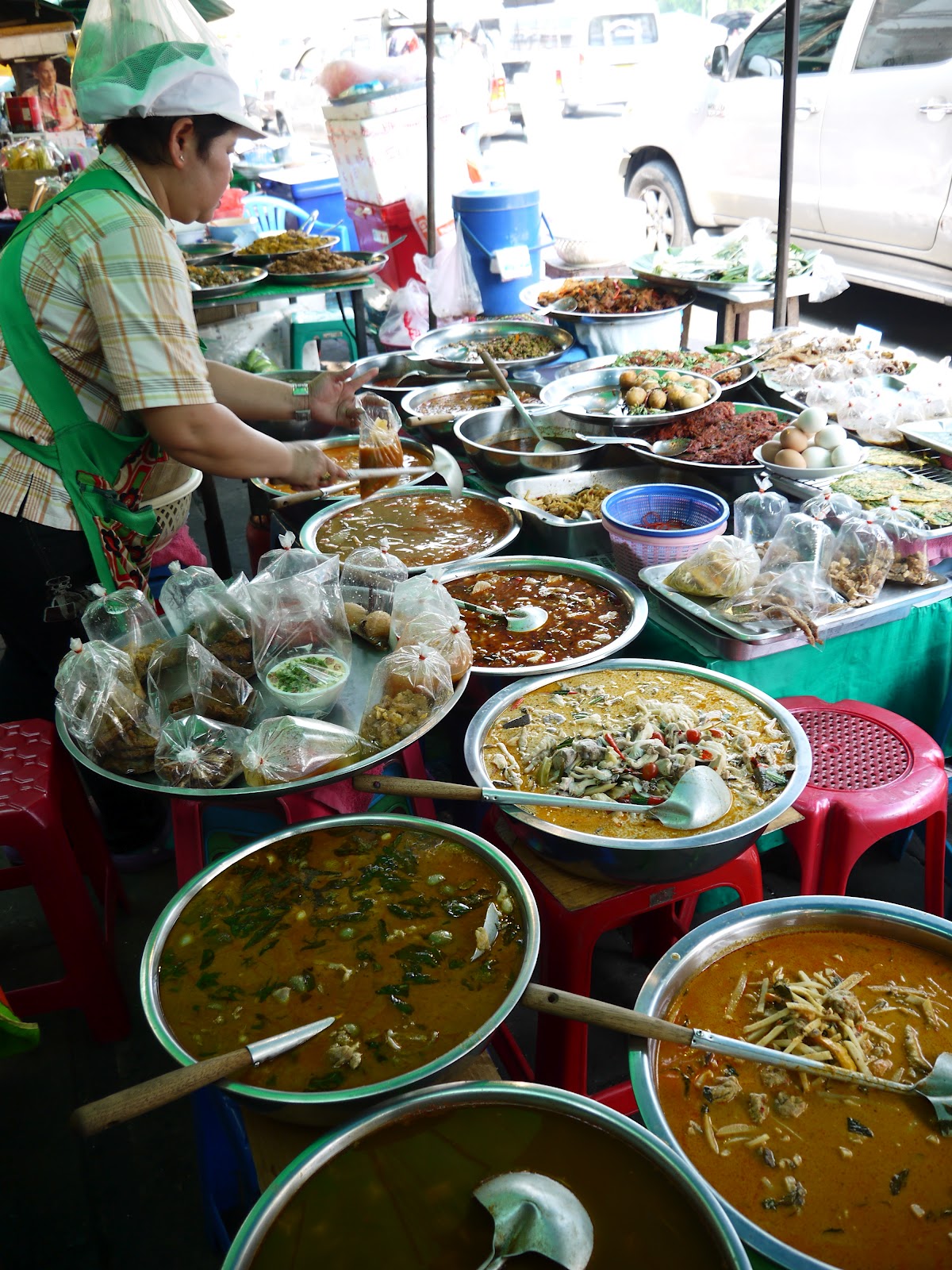
Street Food in Pak Taklong market; sometimes a mystery as to what things are.  Adventures!
Morning traffic in Bangkok: A view from a pedestrian walkway to school
River boat... not very busy today. 
Pak khlong talat vegetable market
Another very fun and interesting thing to see was the vegetable market.  It was packed with vendors selling all sorts of lovely ingredients.  I tried to buy some broccoli for Cathy on my way home (along with rose pears, papaya, and some apples)... it was a combination of charades and a lot of pointing to indicate 1/2 a kg.  The women who sold the vegetables did not know what to do with me.  They keep smiling and saying, 1kg, 100 Baht.  But that would be way too much broccoli for just Cathy to eat.  It was kinda fun play the game of vegetable charades.