Tuesday, April 17, 2012

Angkor Wat (lesser temples)

This morning I started my discovery of Angkor Wat.  I decided upon doing two days of touring, as the grounds of Angkor Wat are so vast, and there are so many temples to see.  Angkor Wat is what everyone calls the entire premises, but it is actually one of the many temples that you can explore.
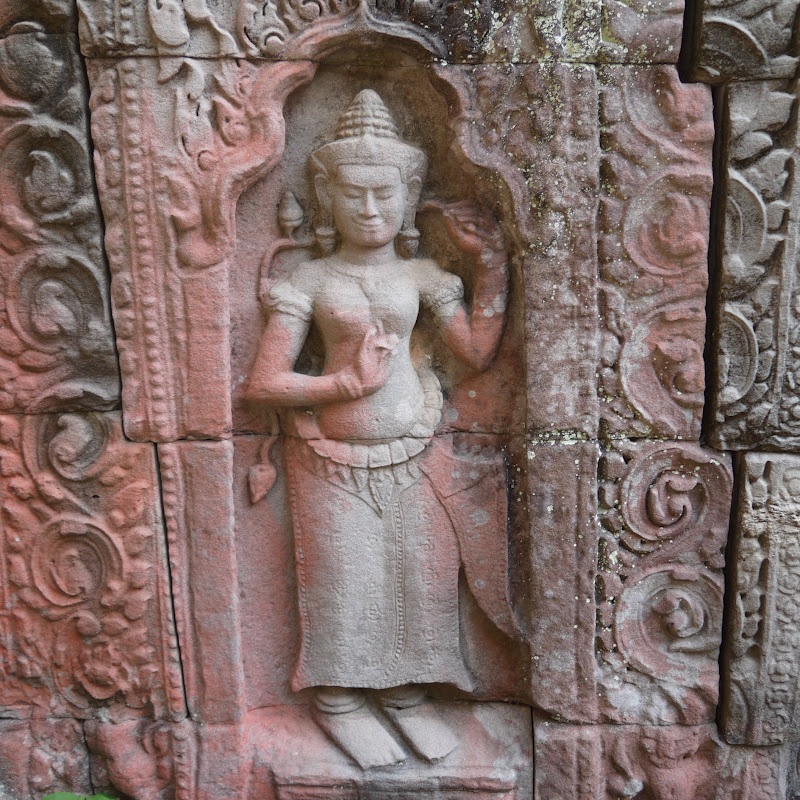
One of the many stone carvings in the walls of the temples.  This one was found at Banteay Srei, or the Citadel of women inspires throught its exquistiely detailed carving. The carving is done in pink sandstone.  The complex was founded in 10th century.
 Angkor is the ancient capital of the great Khmer empire. Angkor is one of the most magnificent wonders of the world and a site of immense archaeological significance. It is located in dense jungle on the hot and torpid plains of western Cambodia. The remains of Angkor occupy 200 square km.  The old wooden houses and palaces that were originally documented to be on the premises are long since decayed centuires ago, but the stunning array of stone temples remain. Set between two baray (water reserviors), Angkor contains 70 temples, tombs, and other anicnet ruins. Among them is Angkor Wat, the worlds single largest religious complex (which I will visit tomorrow).   Today I visited Ta prohm, the famous site of the movie Tomb Raider (it is the place with all the silk trees growing over and on the ancient temples), Pre Rup, East Mebon, Preah Neak Prean, and Preah Khan... to name a few.
There were some Japanese tourist who hired 3 Cambodian women dressed in traditional clothing to pose for a photoshoot amongst the temples.  I joined in the opportunity to get some really cool shots of these women.  This site is Preah Khan. Named for the sacred sword owned by its 9th century king. This site functioned as a monastery and religious college.  The complex is over 141 acres and surrounded by 3 km long laterite wall.  One of the main highlights of this temple is the Hall of Dancers.  This temple also has great trees whose creeping roots cover and in places pierce the laterite and sandstone structures. 
A monk "giving" (aka selling) good fortune bracelets amongst the ruins at Preah Khan
One of my favorite shots of the day. These faces were so mysterious looking at Preah Khan
Buddha faces that could be seen at the top of one of the entrance gates
One of the famous silk trees growing amongst the ruins at Ta Prohm, where the movie Tomb Raider was filmed.  This is the most evocative and mysterious of all the temples in Angkor.   Ta Prohm means Ancestor of Brahma, which was originally a Buddhist monastery. At its peak it owned more than 3000 villages, and was maintained by 80 000 attendants, including 18 high priests and over 600 temple dancers.  During the restoration process of Ta Prohm little of the dense jungle was cut down, and as a result the roots of the giant banyan tress can be seen growing and creeping all over the sandstone rocks. 
Postcard?
Laura Croft/Angelina Jolie?  Nope, just a sunfried Canadian tourist.

Monks seen walking around Pre Rup temple
I was stunned by the beauty and the magic of the temples I had seen today.  Ta Prohm was my favorite.   I am going to be rising very early tomorrow to be at Angkor Wat for Sunrise.  Apparently it is a must do!  I cannot wait. This site is supposed to be even more grand than what I had seen today.  I cannot imagine this is possible. 

Monday, April 16, 2012

Floating Villages

Floating Villages of Chong Kneas

My first day in Siem Reap, I decided to visit the floating villages of Chong Kneas.  Unlike Bangkok, the floating villages are a place where families live, and not just sell goods.  According to my boat guide, there are about 6000 inhabitants of the first village I visited.  With an average of 7-10 people living in one boathouse; typically 5 children, 2 parents, and possibly the grandparents.  90% of the people who live in this village are fishermen.  It is currently the dry season, so the waters are about 1 meter deep, but during the rainy season, the waters can be up to 10 meters deep. Because the water is so low, the fishing is very abundant during this time of year.  Currently the price of fish is very low at the markets, because there are so many to be had. I was told year in particular has been very good for fishing.  


Everything can be found within these villages; school, basketball court, store, restaurant, an orphanage, etc.   We visited one floating restaurant that was run for tourists.  It had an crocodile farm within its premises, and you could get your picture taken with a snake (ugh... no way!). 
Since the waters are so low during this time of year, you can see children or adults climbing in and out of the waters, walking around on the lake floor to do repairs on their boats, or other tasks.  The waters are about chest level of most adults. At one point our boat became untied from the restaurant we were visiting and the "boat boy", quickly tore off his clothes, jumped into the browny waters and fetched the boat for our driver.  

On route to the floating villages, which are seen along the horizon.

How many Cambodian's can you fit into a boat?
Second Stop: Floating Village of Kompong Pluk

The second floating village I visited was Kompong Pluk, where the houses are built on "land" with long stilts.  It is an other-worldly place.  Most of the houses are almost bamboo skyscrapers and it looks like its straight out of a film set. The houses are located on a river which leads out to the nearby lake.  Apparently the waters of the river during the rainy season come almost right up to the floors of the houses.  While I was visiting the water was incredibly low, and we had difficulty navigating between the boats due to the lack of water. The river was about 5 meters wide, with boats docked on either side; not leaving much room to maneuver between as we made our way out to the lake. I enjoyed this village more than the first, as there were far less tourists (aka Japanese tourists, armed with cameras) and it was so unique!  The houses look so unstable on their foundations I wonder if any topple over during the dry season.     
I was the only tourist on this boat... besides the boat driver and Ruthi my driver
Imagine bringing groceries up these stairs? 
The "bushes" you see on land, are actually nets.  The fish swim into the bush and get caught.  The fishermen lift them out of the water and empty out the fish.

After the morning of floating villages, I grew tired of the heat. Since it is the dry season, the temperatures are balmy 35-40 celsius.  I retired for the afternoon at my hotel.  Much like the roads in Sri Lanka, the roads in this area of Cambodia are very dusty, and I had to scrub down after being on a motorcycle for most of the morning.... even making sure to clean behind my ears.  Its a dusty adventure on a motorcycle!


night market

After arriving in Siem Reap, I made my way over to my new "home" Tara Angkor Hotel.  It is a pretty fancy place for someone who is totting around a backpack.  But I think I will manage to settle in.  I think it would be considered a 5 star hotel.  I figured I deserved a little luxury after 2 months in Sri Lanka. 

When you arrive at the airport in Siem Reap you are greeted by a whole fleet of taxi services.  I decided upon the cheapest mode of transportation; a motorcycle, $2.  I hopped on the back of a motorcycle with my large pack in front, between the driver's legs, and my smaller pack on my back.  My driver was a very friendly person and asked if I needed his services during the rest of my stay. I said yes because he seemed very informative and helpful.  He is called Rith (silent "h").  He was very careful and drives at a decent pace (unlike people in Sri Lanka).


That night I arranged for Rith to pick me up so I could venture off to the night market.  This is an area of town that has outdoor shops and stalls, which are open until midnight.  It was a bustling area, with venders trying to sell you all sorts of Cambodian goods; silk scarves, silver, leather goods, all things crocodile skin (see picture), t-shirts, etc, etc, etc.  All prices are negotiable.  The more you pretend not to care and want to walk away from a sales person, the lower the price goes. One lady tried to sell me a bracelet for $45, then when I said no and started walking away it went down to $20.  I soon learned the art of bargaining.  I got a solid silver bracelet for $5.  Crazy!
After 2 hours of walking the streets and buying a few things, I decided to head home and get some shut eye for tomorrow's adventure to the floating villages. 

Saturday, April 14, 2012

Funny Signs

This sign was outside a public toilet house.

Not sure if I would want to get medications from this "pharmecy". 

Enough said; dont want to go here!
I love the "classic man"store.  Or the "Hello"mobile world... ha ha

Fashion mart; a typical store for clothes in Sri Lanka.  Not high fashion

Thought the English was funny on this sign


Would not want to escpae a Tsnami in this wooden boat!

Friday, April 13, 2012

Final thoughts on Sri Lanka


There have been many ups and downs on this trip, but I can honestly say it has been mostly ‘ups’.  I feel very privileged to have glanced into the everyday lives of Sri Lankans.  I will never forget this experience and everything I have seen.  Above all I will never forget the people I have met and the kindness they have extended towards me.  I hope to one day be able to pay forward the generosity of the people I have met. 
Next stop: Cambodia!  

Thursday, April 12, 2012

Tamil New Years


On last evening in Trinco Nixon was in town.  He invited me to go out for dinner and drinks to celebrate my time in Sri Lanka.  We met at the Green park hotel and first set about arranging my transport to Columbo for the following day.  Then we went to a local bar that Nixon often visits when he is in Trinco. It was a cute little place that had a “jungle” theme (I say that in quotes, because it was a very poor version of a jungle theme).   We shared a lot of beer and discussed my experiences at the clinic, his family, the differences between Western and Eastern culture, etc.  It was a nice way to finish my time in Sri Lanka. 

The next morning Nixon insisted on bringing me to the bus station.  He wanted to make sure I had someone to wave goodbye to from the bus.  I thought that was very sweet of him. As my backpack was tossed into the back of the bus (I cringed as this was being done, because I saw it was amongst boxes of fish and rice… which would be inevitably tossed about while on the bumpy roads…. Yummy, fish juices… agh), I hugged Nixon goodbye and thanked him for everything. 

I arrived in Columbo dusty, and tired from my 7.5 hour bus ride. It was not the best bus experience, as I was crammed into the back corner seat of the bus. However, I was thankful for actually having a seat.  Some people stood up for the entire ride.  For more than half of the trip I sat next to a man who insisted on sleeping all over the people next to him.  At one point he was almost lying on the man’s lap next to him.  I thought I was safe, but then he changed positions and then started leaning on me.  The next thing I knew his head was on my shoulder, and his hair was on my neck.  I had to constantly shrug my shoulder in an attempt to get him off me.  This did not work and finally I succumbed to having a strange man’s head on my shoulder.   This was the second time I had a man resting his head on my neck while on one of my bus trips.  The last time was on the bus from Jaffna to Trincomalee.  At the time, I thought nothing could be worse, but in fact it was better when he was sleeping than when he woke up.  While awake he tired to get me to buy him a Canadian visa, get my phone number, my email address, facebook, work for me, get me to find him a job in Canada, etc.  He was relentless.  When he finally left he gave me his business card and told me to call him.  

When I arrived in Columbo I was lucky enough to have a place to stay.  My Swedish friends gave me the keys to their apartment, as they had gone home to Sweden to get married, but insisted I use their place.  They live in the downtown core of Columbo, which was very handy.  It was so nice to come to an apartment where I could wash my clothes in a washing machine (7 weeks of hand washing clothes in bathroom sinks is not fun), make my own food, and relax at the roof top pool.
Unfortunately for me, it was Tamil New Years when I was in Columbo.  I thought this would be a fun time to see festivals or parades, but nothing was going on.  They don’t even serve alcohol during this holiday, and all the bars, restaurants, stores, etc are closed.    

A few weeks prior to my arrival in Columbo, I had met an American guy in Trinco.  I met him while staying at the Green park hotel.  We had dinner together one evening and arranged to meet up in Columbo to celebrate New Years. Gabriel was an extremely interesting guy; he went to ACAD (art school in Alberta), where he studied all sorts of very creative and interesting things (so cool).  I thoroughly enjoyed spending time with Gabriel and the conversations we had. Gabriel lives in Portland, where he designs and makes puppets for the film industry (soooo cool).  He had come to Sri Lanka and rented a motorcycle to tour around on.  He showed me his trip pictures, talked about what it was like to drive a motorcycle in Sri Lanka and we talked about life as a Westerner in the East.  It was great fun.  Since there wasn’t any alcohol or bars open for New Years we celebrated over fresh mango juice and some yummy street food (I had vegetable kotthu, and he had some noodle dish).  

sorry folks... not really that many pictures from Columbo.  

Sunday, April 8, 2012

Easter Sunday

Having not had enough of the luxurious atmosphere of the Chaaya hotel, I decided to return there for Easter Sunday.   I grabbed a tuk tuk from the Green park hotel, and headed over.  On route we passed a funeral procession.  First was a small tracker with a trailer filled with sand, with a man scooping out the sand onto the road behind.  This was followed by a couple of men sweeping the sand over the asphalt, a hearse with a casket hanging out the back door, and ended with men following behind the vehicle.  I was told the sand is believed to stop the spread of bacteria that the decaying body would produce.  


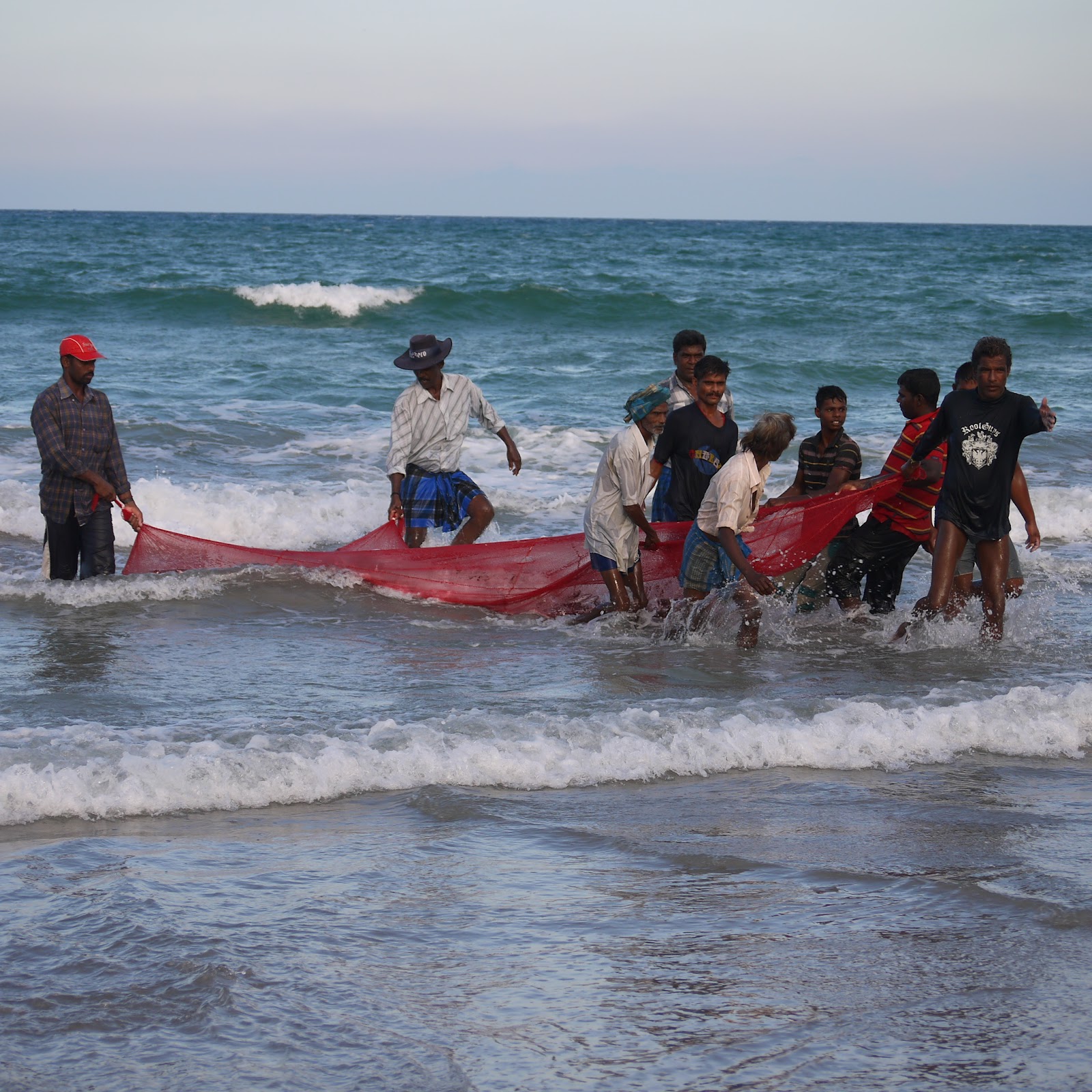
I spent the day reading my book and people watching by the pool.  When I grew tired of this, I switched it up for the beach.  Later in the afternoon, as I was packing up for the day, I noticed a huge commotion on the beach.  A large crowd of Sri Lankan men were gathering to bring in some fishing nets.  I had seen the nets being hulled in a couple of times now; I thought it was strange that men would be running over to help, as typically only 30 fish are caught in the nets.  So I decided to investigate.   As I walked over I saw piles and piles of fish on the beach, and more were being hulled onto the shore.  Lots of shouting was going on, as men were sorting out the fish, rinsing them in baskets in the ocean, weighing the baskets and loading them onto a truck.  

The previous day I had struck up a conversation with a man selling souvenirs outside of the Chaaya hotel.  He had asked me what I was doing in Sri Lanka, and I explained my volunteer work.  He quickly pulled out a certificate he had received for his service with the Red Cross during the war and the tsunami. He was very proud of his 7 years working for the Red Cross and was excited to share his experiences. When I was on the beach watching the fishermen pulling in their nets, my friend from the Red Cross greeted me.  He was wearing his Red Cross shirt and had a big smile on his face.  I made a joke about the irony of today’s catch being on Easter; it’s an Easter miracle, I said… but I am not sure he understood my joke, as he is Hindu.  My friend bought some fish, and invited me to come back to his hut to try his fried fish.  He said it would be the best fish I would ever have.  I tried to decline his offer, as I knew how poor he was, but he insisted.  So we went back to his “home” to prepare the fish.  I did not realize his home was the small hut that he sold his souvenirs out of.  (you can see it in the pictures, it is the small wooden shack in front of the pink building… he does not have any access to the pink house in behind).  When I asked where he slept he pointed out a bamboo mat that he rolls out at night to sleep on the concrete floor.  The hut is barely long enough for someone to lie length ways.   


Quickly my friend ran to his neighbors house to get a bucket of water to clean the fish.  He spiced it with some curry, and was already previously salted from the ocean. He cooked it up on a small camping stove outside his home.  

He pointed out two dogs that live outside his place. He said they were his pets.  He had adopted them after they had been dumped in the back alley behind his home.  They were only a few days old, and he nursed them with milk and has been feeding them ever since.  Another very interesting thing he did was neuter the dogs.  This is not a common thing in Sri lanka; stray dogs can be seen everywhere.  The sleep in the middle of the streets and roam the cities for food.  I thought it was very responsible of him.

As we sat and ate the fish he told me about his family which lives in Columbo.  He is trying to save up enough money to bring his wife and 3 children up to Trincomalee.  He also wants to rent out the pink house behind his place, so he can turn it into a souvenir shop.  He has to wait until the lease expires on the current tenant, before this can happen.  My friend from the Red Cross is from a family of 13 children, with 4 boys and 10 girls. He explained that it is the responsibility of the men in the family to ensure the women have a dourly and a house before they are married.  As a consequence, because he was one of the eldest in his family he did not marry until he was 38 years old, (which is quite late for a Sri lankan man), so that he could build the houses with his father and brothers.  
I thanked my friend for the tasty fish and he said to me: “it was my pleasure.  It will be an experience I will remember for the rest of my life”.  It was so sweet of this man to open his house to me, and share a meal together.  Definitely a memorable moment.